Disposables are cheaper for the first fortnight and more expensive after that. A moderate user spends roughly $200–$280 a month on disposables against $30–$50 on a refillable kit once the device is paid for — over $2,000 a year apart. Disposables also discard around a hundred lithium cells a year, which cannot go in kerbside bins.
Are disposable vapes cheaper than refillable kits?
Disposable vapes have exploded in popularity over the past few years, and it's not hard to see why. They're cheap upfront, require zero setup and come ready to use straight out of the packaging. But is that convenience worth it in the long run? Let's compare disposables with reusable kits across the factors that matter most.
Convenience
Disposable Vapes
Maximum convenience. Unwrap, vape, dispose. No charging (in most cases), no refilling, no coil changes. When it runs out, you grab a new one. For people who want the absolute simplest experience, disposables can't be beaten.
Reusable Kits
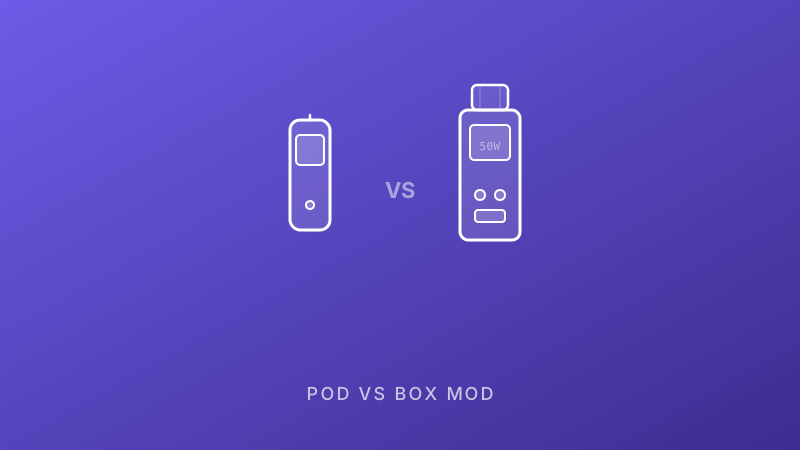
Slightly more involved, but still quite simple — especially with modern pod systems. You'll need to charge the device, refill or replace pods, and occasionally swap coils. Once you're in the routine, it takes less than a minute. Most reusable devices charge via USB-C, which is quick and convenient.
Cost
Disposable Vapes
Cheaper upfront but more expensive over time. If you're vaping regularly, the cost of disposables adds up quickly. A daily vaper might spend significantly more per month on disposables compared to refillable pods and e-liquid.
Reusable Kits
Higher initial investment, but dramatically cheaper in the long run. A quality pod system costs $30–$60 upfront, and ongoing costs for e-liquid and replacement pods or coils are a fraction of what you'd spend on disposables. Over six months, the savings are substantial.
Flavour and Performance
Disposable Vapes
Disposables offer decent flavour, but because the coil degrades throughout the life of the device, the quality drops off toward the end. You're also limited to whatever flavours are available in disposable format.
Reusable Kits
Refillable devices generally offer better and more consistent flavour, especially when you're using a fresh coil. You also have access to a vastly wider range of e-liquids — any flavour, any nicotine strength, any PG/VG ratio.
Environmental Impact
Disposable Vapes
This is the biggest drawback. Disposable vapes create electronic waste — each unit contains a lithium battery, a circuit board and plastic housing that typically end up in landfill. The environmental cost is significant, especially at scale.
Reusable Kits
Far less wasteful. The device itself lasts months or years, and only small components like pods and coils need regular replacement. While not zero-waste, reusable kits are a much more environmentally responsible choice.
Our Verdict
Disposables have their place — they're great for trying vaping for the first time or as a backup when your main device is charging. But for regular vapers, a reusable kit is the smarter choice on almost every front: cost, performance, flavour variety and environmental impact.
Ready to make the switch? Browse our pod systems and starter kits to find a reusable setup that suits you. The Relx Vape Australia team is happy to help you pick the right one.
How much do disposable vapes cost per year?
Disposables win on the shelf and lose badly over any meaningful period. The figures below assume a moderate user getting through roughly one 3,500-puff disposable every three days, against a refillable pod kit with equivalent consumption.
| Period | Disposables | Refillable pod kit | Difference |
|---|---|---|---|
| Week 1 | $50 – $70 | $70 – $110 (kit + liquid + pods) | Disposables ahead |
| Month 1 | $200 – $280 | $95 – $150 | Refillable ahead by ~$100 |
| 6 months | $1,200 – $1,680 | $220 – $350 | Refillable ahead by ~$1,000+ |
| 12 months | $2,400 – $3,360 | $400 – $620 | Refillable ahead by ~$2,000+ |
The crossover happens inside the first fortnight. After that the gap widens fast, because with a disposable you are buying the battery, the coil and the casing again every few days — hardware that a refillable device reuses for a year or more.
When are disposable vapes the better choice?
The cost case is one-sided, but that does not make disposables pointless. They are the better choice when:
- You are trying vaping for the first time and do not yet want to commit to a device and a liquid.
- You vape occasionally — a refillable kit left unused for weeks will have flat batteries and stale liquid when you reach for it.
- You need something for a single occasion where carrying a bottle and a device is impractical.
- You want to test a flavour profile before buying a 60 ml bottle of it.
Environmental reality
Every disposable contains a lithium cell, a heating coil, plastic housing and residual e-liquid. None of that belongs in kerbside recycling, and none of it belongs in general waste either — lithium cells in waste streams are a genuine fire risk in collection trucks and sorting facilities.
A moderate user getting through two a week discards roughly a hundred lithium cells a year. Battery drop-off points at major retailers and council transfer stations accept them free of charge, and using those is the minimum responsible handling. It is also, straightforwardly, the strongest practical argument for a refillable device.
What you gain by switching
| Disposable | Refillable kit | |
|---|---|---|
| Flavour choice | Whatever the brand makes | Effectively the entire market |
| Nicotine control | Fixed, usually high | Any strength; can step down over time |
| Consistency | Fades through the final third | Fresh coil restores it fully |
| Battery | Discarded with the device | Recharged for a year or more |
| Repairability | None | Coils, pods and seals all replaceable |
| Waste per year | ~100 lithium cells | 1 device, recyclable at end of life |
The nicotine control point deserves emphasis. Disposables come at a fixed, usually high strength, which makes stepping down impossible without switching products entirely. A refillable device lets you move from 25 mg to 20 to 12 to 6 over months, which is how most people who want to reduce their intake actually do it.
Making the switch without friction
- Match the draw. Pick a pod kit with a tight mouth-to-lung draw — that is what a disposable gives you, and a loose airy device will feel wrong.
- Match the nicotine. Most disposables sit around 20 – 50 mg salt. Start at a comparable salt strength rather than dropping straight to freebase.
- Match the flavour family. If you have been on iced fruit, start there rather than jumping to tobacco.
- Buy spares immediately. A spare pod and a second bottle. The most common reason people revert is running out.
- Keep one disposable as backup for the first fortnight. It removes the pressure and most people stop reaching for it within days.
Browse disposables if that is what you need today, or compare refillable pod kits for the longer term.